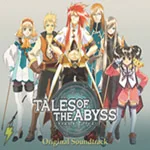
 | Album Title: Tales of the Abyss Original Soundtrack |
| Record Label: King Records | |
| Catalog No.: KICA-1393/6 | |
| Release Date: March 22, 2006 | |
| Purchase: Buy at CDJapan |
Overview
Tales of the Abyss is a very special game, for a few reasons. One, the release of the game marks the 10th anniversary of the very first game of the series, Tales of the Phantasia. Two, it is also the first ‘Tales of’ game to use fully streamed equipment for the musical compositions. Traditionally, a ‘Tales of’ game focuses on gameplay rather than story. After the diversion of Tales of Legendia, featuring Shiru Masaru, the composers who have consistently contributed to the series — the immensely popular Motoi Sakuraba and the somewhat mysterious Shinji Tamura — are back and better than ever. However, they are joined by Motoo Fujiwara, the frontman for the Japanese band Bump of Chicken, who contributes a little to the score.
Body
For starters, like a traditional ‘Tales of’ game, the composers and which tracks they composed are not listed in the soundtrack’s liner notes (with the exception of Fujiwara, whose tracks are credited). This is annoying, especially considering that Fujiwara gets a whole page with the production credits of his tracks and Sakuraba and Tamura get nothing. Thankfully, each composer’s tracks can be determined because they have different styles and use different sound equipment. We can identify Sakuraba’s tracks by his traditional brassy style (often with operatic vocals and piano as lead) and his progressive rock influence. He also uses the best sound equipment of the three. Tamura has a fairly ambient and progressive style, while his tracks are mostly upbeat. His equipment is somewhat basic; the drums and percussion are always the dominant-sounding instruments but don’t have the smooth sound of Sakuraba’s equipment. Fujiwara’s credited tracks are known, and his sound equipment ranks somewhere between Tamura’s and Sakuraba’s. It’s generally clear and pleasant, but the instruments often sound synthetic and fake.
As mentioned earlier, Sakuraba’s style is very predictable, yet his tracks on the Original Soundtrack are the best by far. Let’s start by discussing his progressive rock tracks. “The Arrow Was Shot” is the main battle theme of the game. It’s a delicious theme that focuses on fast synthesizer movements and blazing synth-electric guitar action. This is the style to expect from the battle themes in the score; other battle themes also use Sakuraba’s synth-electric guitar as the central focus. His orchestral themes are also very good. The brassy ones, like “Crimson Pride”, are, for the most part, epic and enjoyable, while the more mellow themes (the end credits title, “The Look of That Day”, for example) are simply divine. There aren’t a lot of filler tracks produced by Sakuraba, but some of his typical brass tracks are bland. This shouldn’t be surprising for anyone who likes Sakuraba.
Tamura’s tracks are much less memorable. On the Original Soundtrack, he contributes a lot of ambient tracks which have a signature style. Most of them are nice and do their job well, but I fail to find more than a few particularly impressive tracks. One highlight is “The Floating Imperial Castle,” where he uses a harp and a flute to convey lightness. It works really well. But tracks like “Mushroom Road” are just plain weird, albeit interesting. Usually, in the past, each ‘Tales of’ game has had a roughly balanced number of Tamura and Sakuraba tracks, but in Abyss it seems Tamura composed, to put it into perspective, about half as much as Sakuraba. Overall, his contributions are a little bland, but I am happy with them.
Lastly, Motoo Fujiwara composed the fewest tracks, but they are all significant in their own way. However, the really good Fujiwara tracks are, truthfully, only on Disc Four. “Mirrors” is a great arrangement of the game’s main theme, “Karma,” which is composed and sung by Fujiwara and performed by his band (though that track isn’t included on the Original Soundtrack). His other impressive arrangements of “Karma” include “Meaning of Birth” and “Promise.” Fujiwara also composes the music to the final battle and the events leading up to it. I rather enjoy “Time to Raise the Cross” (one of the last battle themes), even if it seems a little too predictable. The same goes for “Finish the Promise,” the final battle theme. “A Song ~ Song by Tear~” is a pleasant vocal piece sung by Yukana Nogami. There is very little instrumental work, as Fujiwara turns all focus to the vocals. It’s short but sweet, and ends his compositions wonderfully.
Summary
Now that you have had a brief read on what each composer brings, the question remains whether it is good enough for you to own. Well, the ‘Tales of’ series has always had a bundle of filler tracks, but this score is almost completely rid of them; they are replaced by, on the whole, satisfying and solid compositions. Not only is this a good reason to buy the album, but it is without doubt the best ‘Tales of’ soundtrack thus far (not including Tales of Legendia, which was made by a completely different group of developers). For a Sakuraba fan, this score contains some excellent work from the artist (although for a better Sakuraba experience, the Baten Kaitos II Original Soundtrack, which was released two days after the Tales of the Abyss Original Soundtrack, is the more complete choice). Fans of Shinji Tamura should be content with his work. The Tales of the Abyss Original Soundtrack is definitely a good album to own!