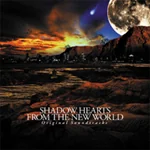
 | Album Title: Shadow Hearts -From the New World- Original Soundtrack |
| Record Label: Team Entertainment | |
| Catalog No.: KDSD-00078/9 | |
| Release Date: August 24, 2005 | |
| Purchase: Buy at CDJapan |
Overview
Yoshitaka Hirota used to be a Square employee who specialised in the sound effects department, and, with experience from games like Final Fantasy VI and Chrono Trigger behind him, he soon decided to set out on a compositional journey as a freelance artist in 1999. Alas, he arrived upon the scene of the Shadow Hearts Original Soundtrack plus 1 in 2001 to compose an impressive gem whose epic qualities were only really noted upon its re-release in 2005. Hirota certainly gained a lot of popularity thanks to his efforts on this album, and so he was called back to compose for the Shadow Hearts II Original Soundtrack in 2004. Indeed, with the Shadow Hearts series receiving such recognition in the game music world, it was only natural that the games would become increasingly popular, too. Many fans found themselves buying the games solely to experience the soundtracks, which in most people’s eyes were amongst the most diverse scores to date.
Shadow Hearts II or Shadow Hearts: Covenant proved to be an excellent sequel to the first game, with its interesting gameplay and inspirational storyline sweeping the world. The soundtrack for the game was one of its best parts as it managed to mix so many styles and feelings that it became an invigorating experience. With Hirota having been assisted on previous scores, Aruze Corp decided it was the right time for him to play an even wider role, composing even more diverse tracks than on any prior albums. So, by ditching Yasunori Mitsuda and Kenji Ito and introducing Tomoko Imoto and Ryo Fukuda, the marvellous epic known as the Shadow Hearts -From the New World- Original Soundtrack emerged. There is seemingly no decrease in variety with this soundtrack, but rather an increase in passion. Only recently released in August 2005, this album will be greeted by many as perhaps the greatest Shadow Hearts score to date.
Body
The album starts off with a typically awe-inspiring Hirota track. With a dominance of female vocals, a heavy guitar bass, and an invigorating violin line, “From The New World” turns out to be an inspirational composition. Soon to follow is an ICARO theme; ICARO themes are a signature track of the Shadow Hearts series, and “Et Unam -Chant Of ICARO-” proves to be no different in style from the others. This track enhances the soundtrack with its presence, and with this being the best ICARO arrangement to date, one can’t help but feel the album is going to be wonderful. Once again, the interweaving female vocal chanting gives the track its edge, and with the singers doing the majority of the work, it’s clear that melodic emphasis will grow to become a major feature of the album. The album begins to intensify with the ominous “Ala of Sacrum” before the introduction of the main battle theme, “Dead Fingers Talk”. On the whole, the opening tracks are profound, leaving us in anticipation for the rest.
Hirota takes the lead in the area of dark tracks, featuring a great deal of rhythmic and harmonic depth. “Dead Fingers Talk” is a track that relies completely upon an aura-boosting drum line and an increasingly tension-filled electronica melody. It proves to be one of the most impressive tracks on the album by retaining the bass guitar-driven feel of Hirota’s previous main battle themes, but integrating all sorts of novel features to make it unique. Hirota uses similar techniques with “A Silver Smile” and “Kiss of Malice,” too, and it is in these two tracks that harmonic diversity becomes evident. Through other, more complex tracks any real tension and sense of action is brought about. The perfect example of this comes on the first disc, and with its swiping violin notes and a series of Psycho-esque chord strikes, “Muy Malo” ranks as one of the most inspiring tracks to date. “Le Gran Luxe” is another of these, somehow creating a smell of blood through its powerful harmonies and erratic rhythms, while “Malice” reflects Hirota’s industrial rock flair wonderfully.
Tomoko Imoto’s tracks are unquestionably the simplest tracks on the album. Tracks like “Pirates of the Caribbean,” “By a Moustache Hair,” and “Sneaking Heart” may seem feeble in comparison to others, but are enjoyable for their playful nature. One impressive gem is “Tirawa,” a short yet extremely pleasing vocal track. Listeners easily come to understand through these tracks how Imoto loves making his melodies sing (no pun intended!). With this in mind, Imoto finally moves onto the ambient and wistful “Wheel of Fortune.” Admittedly, the track takes longer to develop than others, but when it reaches some heartwarmingly gentle piano chords, a sense of purity like no other track before it is evoked. All in all, Imoto establishes herself as a capable composer with these tracks, surprising many with her melodies, though she takes a subdued role that allows Hirota’s to be emphasised.
The best relaxing themes come from Hirota. It is through tracks like “Deposition Of Memories,” “Whisper of the Wind,” and “Talking About You” that Hirota gets his message of purity across as a unique image — a spiritual one — for Shadow Hearts From the New World. With tracks like “ICARO -acoustic arrangement-” these feelings are put into full effect. This track’s heartrending melodies and passionate harmonies really give the listener something to think about, and with this mood becoming increasingly similar to that of the main theme from Mel Gibson’s Braveheart, one can’t help but sit back and adore it. He is also responsible for lots of light ditties, such as the percussive “Rum and Tequila” and “Garland Office,” a jazzy reflection of Hirota’s diversity.
Eventually, after journeying through fifty-five stimulating tracks, we reach the grand finale of the album. The first track is named after Bythos, the monadic first being and originator of the spiritual world of the Pleroma. “Bythos” proves to be an amazingly fitting track for this legendary beast, as, with its techno bass and intriguing timbre, a sense of enormous power is created. The next track after this is “Lady Tears I,” a powerful and emotional pleasantry that explores a variety of instrumental techniques. Nevertheless, it hardly proves to be as impressive as the subsequent “Lady Tears II,” a track built in two parts. The first part of the track acts as a dark introduction, collating the ideas of a stage-by-stage battle. Then comes a wailing vocal line filled with raw emotion, together with the introduction of a suspense-filled accompaniment. And so, with the majesty of “Lady Tears II” behind us, we are introduced to “Astral Tears,” a brief intensification of the climactic experience.
So, with the album drawing to a close, we are introduced to the main vocal theme, “Spread my Wings.” This rock and folk fusion from Takehara Tomoaki goes through a series of inspirational developments to give the album a well-integrated feeling of pride. So, this then leads us into the next track: the ominous “Un gemito dell’estinto,” or “The Groaning of the Extinguished One.” The best thing about this track is not its written music but its array of sound effects. Hirota proves to be impressive in this area, providing us with many such examples throughout the score. This track reveals a sense of despair through its melodic falls, thus suggesting that the demon may still haunt the lives of the heroes. Even so, we soon reach the last track on the album. “SABBATH -Demon Banquet-” proves to be a very fear-inducing track, with the likes of a pulsating bass and a hardcore guitar taking over in the second section. It proves to be an excellent way to end the album, as, with the first section of the track being reminiscent of the first theme on the album, one can really reflect upon the emotions built up throughout the soundtrack.
Summary
Shadow Hearts From the New World has it all. With Yoshitaka Hirota again taking the front seat, creating his trademark battle themes, a number of industrial rock tracks, some unique spiritual themes, and a diverse array of other contributions, he proves as inspired as ever and offers both continuity and change to Shadow Hearts’ musical franchise. The loss of Kenji Ito and Yasunori Mitsuda is certainly tolerable, since Tomoko Imoto creates a number of noteworthy themes and Ryo Fukuda makes a small but interesting contribution. From its atmospheric beginning to its intense end, the soundtrack fulfils all expectations and generally delights.