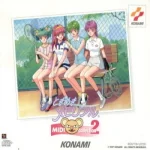
| Album Title: Protect Me Knight -The Princess’ Tokimeki Rhapsody- Soundtrack Vol. 1 |
| Record Label: Sweep Record | |
| Catalog No.: SRIN-1125 | |
| Release Date: March 27, 2015 | |
| Purchase: Buy at CD Japan |
Overview
The Protect Me Knight 2 -The Princess’ Tokimeki Rhapsody- Soundtrack Vol. 1, recently released by Supersweep, contains the soundtrack to the second game in the Protect Me Knight series. While the first game’s soundtrack, yet to be released, was composed by Yuzo Koshiro, as his company made the game, the sequel for the Nintendo 3DS features music by Yuzo Koshiro and other influential 80s game music composers: Hiroshi “Hiro” Kawaguchi, Shinji “Megaten” Hosoe, Motoaki Furukawa, and Hisayoshi “OGR” Ogura, known for their various works for SEGA, Namco, Konami, and Taito, respectively. This collaboration, surprisingly enough, came about on Twitter, as was discussed at the Tokyo Game Music Festival in February, where early release copies of this soundtrack were being sold. Given this collaboration, how does the overall product turn out?
Body
The album opens with Yuzo Koshiro’s “Go! Mamotte Knight!”, which is an extremely upbeat tune with an equally memorable melody. While it is short, as expected given the use of the music in the game, there is a long version found towards the end of the soundtrack that helps scratch that itch. Koshiro’s other contributions include “To Victory!”, a march-like tune that, while not as engaging, does give a sense of preparation for battle, and “From the Darkness,” an eerie piece that conveys an ominous tone. “Crimson Heart,” most likely a battle theme, is frenetic and tense, while “Protect Me Knight Theme” is an upbeat, jovial theme that has airs of celebration. “Three-Colored Sprite” is a more relaxing and pensive tune with a wonderful melody. There is also an up-tempo version of “Crimson Heart” on the soundtrack that makes the piece even more frenetic.
Shinji Hosoe’s “Bon! Voyage” is a bubbly and bright tune with a strong melody. As with Kawaguchi’s tunes, there is also an original song version of his contribution that uses a richer chip library. Motoaki Furukawa’s “Oort Cloud,” of which there is also an up-tempo and original song version, is an excellent tune with some great progression and an overall heroic melody. It is certainly one of the highlights on the album. Speaking of highlights, Hisayoshi Ogura’s “Retro-Nitro-Girl,” of which there is also an up-tempo version, is definitely my favorite track on the album. It has an Asian flair to it, but the melody is what makes it shine. It’s an extremely bubbly and bright tune with a memorable melody. It’s the one tune that I find myself randomly humming. The up-tempo version is also quite nice.
Last, but not least, Koshiro’s “8-bit Memories of Love” definitely hits all the ending theme notes found in the early era of gaming. In addition, there are some chiptune vocals thrown into the mix. It’s a bubbly tune that’s a lot of fun.
Summary
In the end, this collaboration of classic gaming composers manages to create a largely entertaining listen with a variety of soundscapes all done in the classic 8-bit style. Each composer plays to their strengths and the end result is a soundtrack that definitely hits all the nostalgia buttons. In addition, the up-tempo versions, also used in-game, help give a slightly different interpretation of the theme, while the original song versions for certain pieces give a look into what the music would sound like if composed for a more complex chiptune set. For fans of these composers, this album is certainly worth looking into, at the very least.
Thanks to Justin Pfeiffer and Stephen Meyerink for assisting with the tracklist translation as well as providing some insight into how the soundtrack for the game was planned.