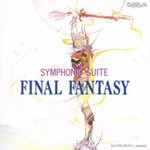
 | Album Title: Final Fantasy Symphonic Suite |
| Record Label: Datam Polystar (1st Edition); Polystar (2nd Edition) | |
| Catalog No.: H28X-10007; PSCR-5253 | |
| Release Date: July 25, 1989; March 25, 1994 | |
| Purchase: Buy at CDJapan |
Overview
The Final Fantasy Symphonic Suite brought Nobuo Uematsu’s delightful melodies to the symphony orchestra for the first time. Unlike most Final Fantasy arranged albums, this suite was recorded during a live concert by the eminent Tokyo Symphony Orchestra rather than in a studio. The album is structured as seven scenes that come together to produce a symphonic suite. Each scene is a symphonic arrangement of one or more themes from Final Fantasy and Final Fantasy II, by father-and-son duo Takayuki Hattori and Katsuhisa Hattori. Although an old live recording, the suite is still highly impressive to this day.
Body
“Scene I”, the arrangement of the “Final Fantasy II Main Theme”, is best described as ‘epic’. It begins slowly with a long suspended tuba note, giving the audience time to sit back; our minds are left to anticipate the awe about to emerge from the shadows. As the cymbals momentously crash, the theme proudly explodes into a rich orchestration. The strings impressively sing out the famous main theme and fill the concert hall, supported by a full choir. As the vocals become increasingly integral to the performance, so does the brass section, which takes the lead in several places once it moves away from the countermelody it initially provides. While the textures are subtly thickened, an evocative chromatic shift marks the recapitulation of the main theme. Nobuo Uematsu’s original melodies were left rather untouched by this arrangement, quite rightfully so, but the Hattoris ensure it goes well beyond the original into a full-blown masterpiece.
“Scene II”, based on Final Fantasy II‘s “Battle Scene 2,” is the weakest addition to the suite. For a battle piece, it seems unusually thin in texture, and rather than relying on an in-your-face instrumental racket to build a tense, battle-like atmosphere, the Hattoris use much more subtle melodic and harmonic methods. Notable are the many chromatic harmonies and dissonant crashes at crucial points. In addition, various synth ‘monster’ noises are well integrated throughout the track, adding further to its strong atmosphere. However, the synth drumbeats detract heavily from the overall success; while they add a battle beat at the beginning, they quickly become annoying and repetitive as they drone relentlessly on. Thankfully, these fade and are less prominent in the last part of the track. Here, a new crisis motif is added that eventually leads the track into what is a rather unexpected and seemingly unfinished conclusion.
The first of several arch-shaped medleys on the soundtrack, “Scene III” is a superbly arranged medley of three Final Fantasy themes. It begins with a straightforward but rousing orchestration of the “Opening Theme” (more commonly known in later soundtracks as the “Final Fantasy” theme). Thereafter the orchestra transitions into a soft woodwind-based arrangement of the “Town” theme that is unremarkable but lovely nonetheless. The smooth transition into “Matoya’s Cave” is even more remarkable. The original is probably the most rounded and atmospheric melody Uematsu created for Final Fantasy, and it works even better on this album thanks to the Hattoris’ appropriate use of instrumental contrasts and the addition of vocals. The best part of the whole scene, however, is the great surge of energy as the scene undergoes a magnificent progression from this theme back to the opener. This brings the track full circle, both thematically and emotionally, and gives additional meaning to the medley.
“Scene IV” is the symphonic arrangement of the Final Fantasy II “Finale” (perhaps better known as “Love Will Grow” from the second Final Fantasy Vocal Collection). Just like the original, it starts off calmly, but is enhanced by the impressionistic touches the Hattoris add along the way. This introduction is primarily based upon a descending harp and glockenspiel arpeggio pattern against the fittingly thin accompaniment of the cello’s long bass notes. Although nothing too fascinating, it allows the statement of the main theme within the first minute of the piece to have much greater impact than it would have originally. As the theme is developed, the instrumentation shifts into a more conventional symphonic tone. It essentially consists of the violins leading, the cello accompanying, and the brass providing a countermelody. Another key feature of this arrangement is the use of dynamics, gradated and shifted to emphasise the emotional quality. The soft interlude around the 3:00 mark and the majestic build-up prior to the end of the piece generate the enormous effects the Hattoris had intended.
“Scene V” is probably the album’s most famous and notable creation, as well as the album’s longest track, topping out at eight minutes. It opens strongly with a bright fanfare-like melody that is entirely unique to this album. The suite then fades into silence and a solo harp gently emerges to play the arpeggio pattern that harmonises the famous “Prelude” theme. A solo flute plays the airy melody that floats over the harp beautifully. These tender tones are not entirely lost as the progression from the “Prelude” to the “Final Fantasy Main Theme” is gradual and effortless. I have to confess that I never had a great passion for Uematsu’s “Main Theme,” but thanks to more orchestral mastery from the Hattoris, this orchestration is highly emotional. As the piece moves into the imposing brass fanfare, the “Chaos’ Temple” theme eventually reaches its long-awaited climax once the full orchestra joins in dramatic fashion. Being the intelligent musicians that they are, the Hattoris are very careful to ensure that the performance doesn’t become an ‘in-your-face’ one by making a much-needed reprise to the “Opening Theme” melody, this time faster than before and complete with some fascinating imitative structures.
The final medley of the suite isn’t quite as impressive, but is notable for the way it gradually darkens programmatically. It begins lightly with the famous “Gurgu Volcano” theme from Final Fantasy. The instrumentation here is appropriately sparse — the Eb Clarinet leads the way with a well-articulated solo and is accompanied delicately by some less distinguished counterpoint from the Bb clarinets and trumpets. The Hattoris lose no time in darkening the theme, however, by making a rather brash yet hardly unmusical transition into Final Fantasy II‘s “Dungeon” theme. The atmosphere brewing in Uematsu’s chord progressions is strengthened by the way the textures progressively thicken up to the final transition, this time into the evil “Imperial Army’s Theme” from Final Fantasy II. By far the darkest addition to the suite, the use of strings particularly emphasises the atmosphere. Unfortunately, however, this theme never really properly concludes, unlike the other scenes, and is left on a rather interrupted note. In some ways, this is appropriate, considering it is an ideal preparation for the last scene of the suite that follows it.
The suite concludes similarly to how it opens, with a single and wholly beautiful arrangement of a highly melodious theme. This one is the “Rebel Army’s Theme” from Final Fantasy II. The first minute of the scene mainly consists of simple homophonic textures of the high strings singing the melody while accompanied by sustained notes in the lower strings; however, at the 50-second mark, in typical orchestral fashion, the brass take over the main theme, playing with an even greater sense of pride and determination. The musicality of such an arrangement only really begins to become evident in the sensitively arranged interlude section that follows, which is entirely unique to this arrangement and demonstrates the Hattoris’ careful interweaving between homophonic and polyphonic textures. From this, with the roar of a triumphant trumpet fanfare, the main melody is revived in its thickest texture, with strings, brass, and vocals all joining together. Such grandeur and magnificence is sustained throughout until the end of the piece and is supported by a modulation to what appears to be a key a semitone higher to maintain interest. A small, yet entirely appropriate, coda finishes the piece with some sustained chords while the grand rounds of applause from the audience in the concert hall give the cheers this suite deserves.
Summary
Even though Final Fantasy Symphonic Suite was the series’ first arranged album, its high quality means it remains one of the very best. The Hattoris emphasise the melodic richness and emotional qualities of Uematsu’s melodies while offering convincing orchestration and novel segments. Their supreme musicality is particularly evident in their structuring of the three medley scenes. Some will find it a little traditional while others will abhor a few moments (e.g. the use of a drum machine in “Scene II”), but most will love the album from start to finish.